


Bienvenidos a El Remate! I’m Aris, a padel-obsessed Missourian who spent two years living in Argentina and Spain to deeply understand the sport’s strategy, culture, and business. I’ve played and competed across 3 continents and 12 countries, and recently started documenting my journey on Instagram.
If you’re new here, you can join our community of padel-addicted subscribers receiving my weekly newsletter on what’s hot in 🇺🇸 & 🌎 padel + occasional editorials (like this one) by adding your email below.
Most of you know the drill by now… every Tuesday, I break down what’s happening in the global padel space from a US POV.
But I also do my fair share of padel travel. I was at the Miami P1 back in March, and that piece landed well enough that when I found myself at the Buenos Aires P1 in mid-May (apparently — per the media registration desk — as the only 🇺🇸 in attendance), I knew I had to write this one too.
Overall, Miami showed me where US padel is, while Buenos Aires showed me where it can be. Both are part of the Premier Padel tour featuring the same players and practically identical prize money, but the sport is embedded in Argentine social life in a way it isn’t Stateside… yet. In the US, padel still feels like something trying to convince you it matters.
Last thing I’ll quickly say, I’m an American who loves this sport and wants it to win at home. Think of this piece as a “here’s what they do right, here’s what we should steal” field report, written by someone who loved being immersed in the havoc, mate, cumbia, puffer coats, and a fan section with drums, horns, and zero interest in letting the poor chair umpire get a word in. I froze my ass off and caught a nasty chest cold, yet would do it all again in a heartbeat.
Anyway, here are my observations from the highest-attended padel tournament ever held:
It’s a completely different atmosphere.
Mate was the stadium’s unofficial sponsor. Hot water, thermoses, yerba, and bombillas were everywhere… I’d estimate ~85% of groups had mate with them. There were official refill stands (~$3 USD per top-up) with super long lines, and signs on trash cans specifically asking people not to dump yerba waste in them. I haven’t seen a beverage and a sporting event this fused anywhere else.
The rampant whistling was also new to me. Miami crowds murmured at tense moments, while Buenos Aires whistled and shouted. I started tracking when it happened and confirmed the pattern with the group next to me: “cuando hay momentos picantes”… aka when things get spicy (i.e., a contentious umpire call, a borderline-intentional body shot, a sloppy unforced error, or players debating something at the net). See what I mean?
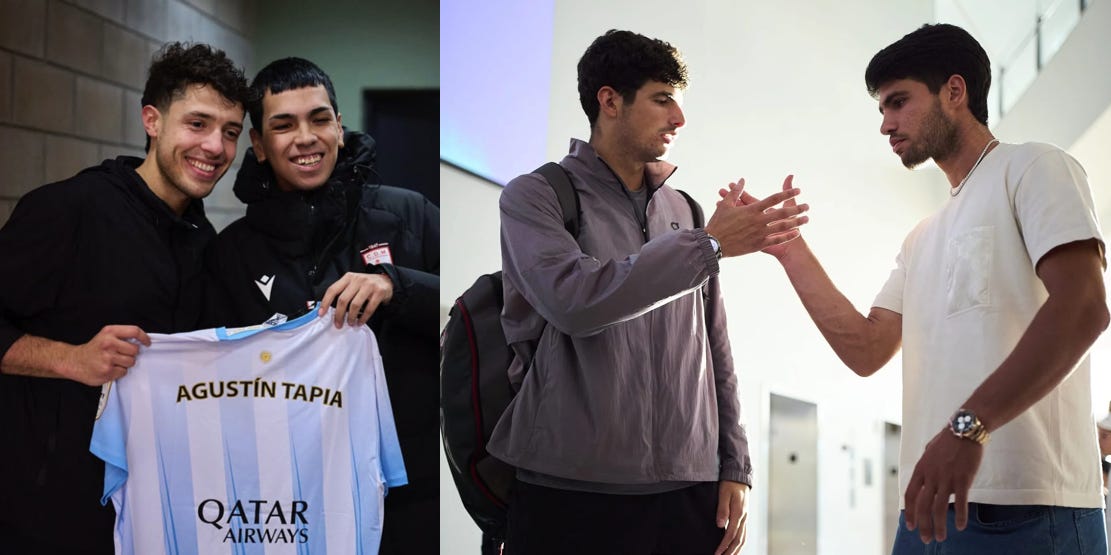
In the Spanish-speaking world, padel has its own celebrity fan culture. Argentine rapper/singer Milo J pulled up and hung out with Agustín Tapia, the same way Carlos Alcaraz cameo’d with Arturo Coello in Miami less than seven weeks earlier. This feels like the padel equivalent of celebrities appearing courtside at an NBA game. I can't help but wonder if that ever becomes normal in the English-speaking world. (And no, Derek Jeter and Jimmy Butler don’t count.)
Even the technical glitches felt more communal. The scoreboard went black periodically; the crowd booed, then erupted ~10 minutes later when it came back. Outside noise was a real problem too… food stands blasted music mid-point, players complained to the umpire, and spectators were visibly annoyed. I expected a “mature” market like Buenos Aires to run tighter than newbie Miami, but it didn't. Doesn't matter… the crowd still had a blast.
There’s a gigantic infrastructure gap.
Estadio Mary Terán de Weiss is a covered, open-air stadium (so no outside wind, but no heating & cooling either) with a ceiling around 140 feet. I thought the ~45-foot ceiling at the Miami Beach Convention Center was somewhat(?) adequate (though I witnessed the ball clip the ceiling at one point in a women’s round of 32 match), until I watched players here rip lobs 70+ feet up without a second thought. Watch the 8:50 mark of this men’s Round of 16 match, for example, and look how long the ball hangs. The whole rhythm of the point is slower, more deliberate, and requires more geometry to (re)cover. Like it or not, seems like we’ve accidentally embraced low ceilings as a distinguished hallmark of American padel. 🤷♂️
The attendee profiles were different too. In Miami, the majority of fans were active padel players and/or those who worked in the space. In Buenos Aires, I talked to tons of people who straight up don’t play. They came for the same reason many Americans who’ve never played baseball still go to MLB games. Clearly, the sport has crossed the barrier from “niche enthusiast product” to “general sports entertainment” in Argentina.
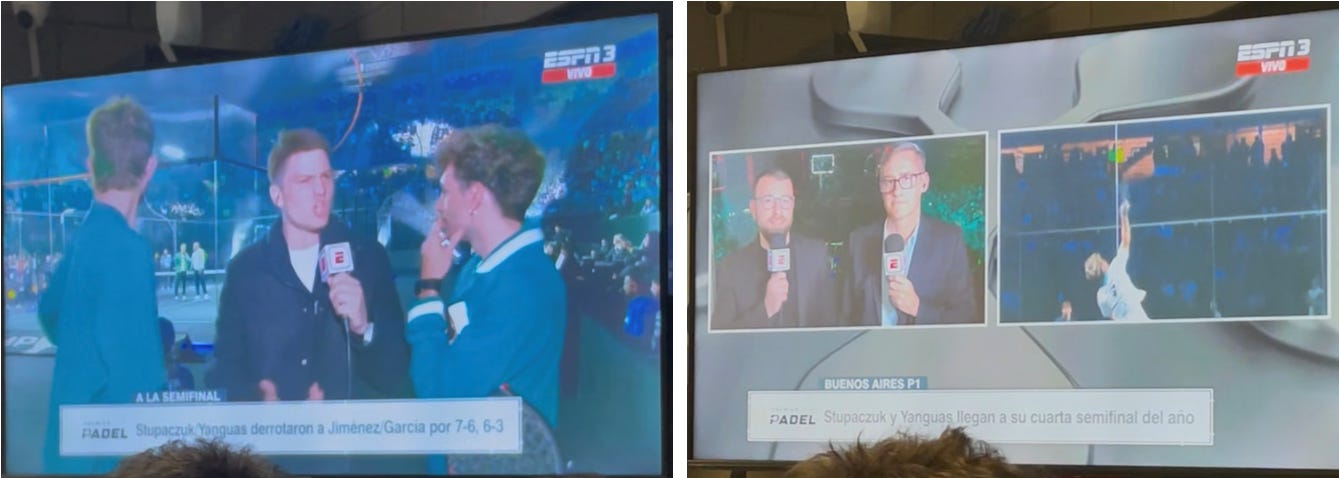
And just like how I’d turn on ESPN to watch an NBA game back home in the States, I can turn on ESPN in Argentina and find Premier Padel. Commentators, match breakdowns, post-match analysis, everything. Meanwhile in the US, our coverage is fragmented across Red Bull, YouTube, and tour-owned platforms that mostly reach people already inside the ecosystem in a “if you know, you know” kinda way. Until padel lands on a major US broadcast network, the fan base will keep recruiting almost exclusively from people who already play.
That gap showed up in the stands too. A Tuesday afternoon Round of 64 here had more people and energy than plenty of the later rounds I watched in Miami, and enough fans to fill Miami’s entire Center Court.
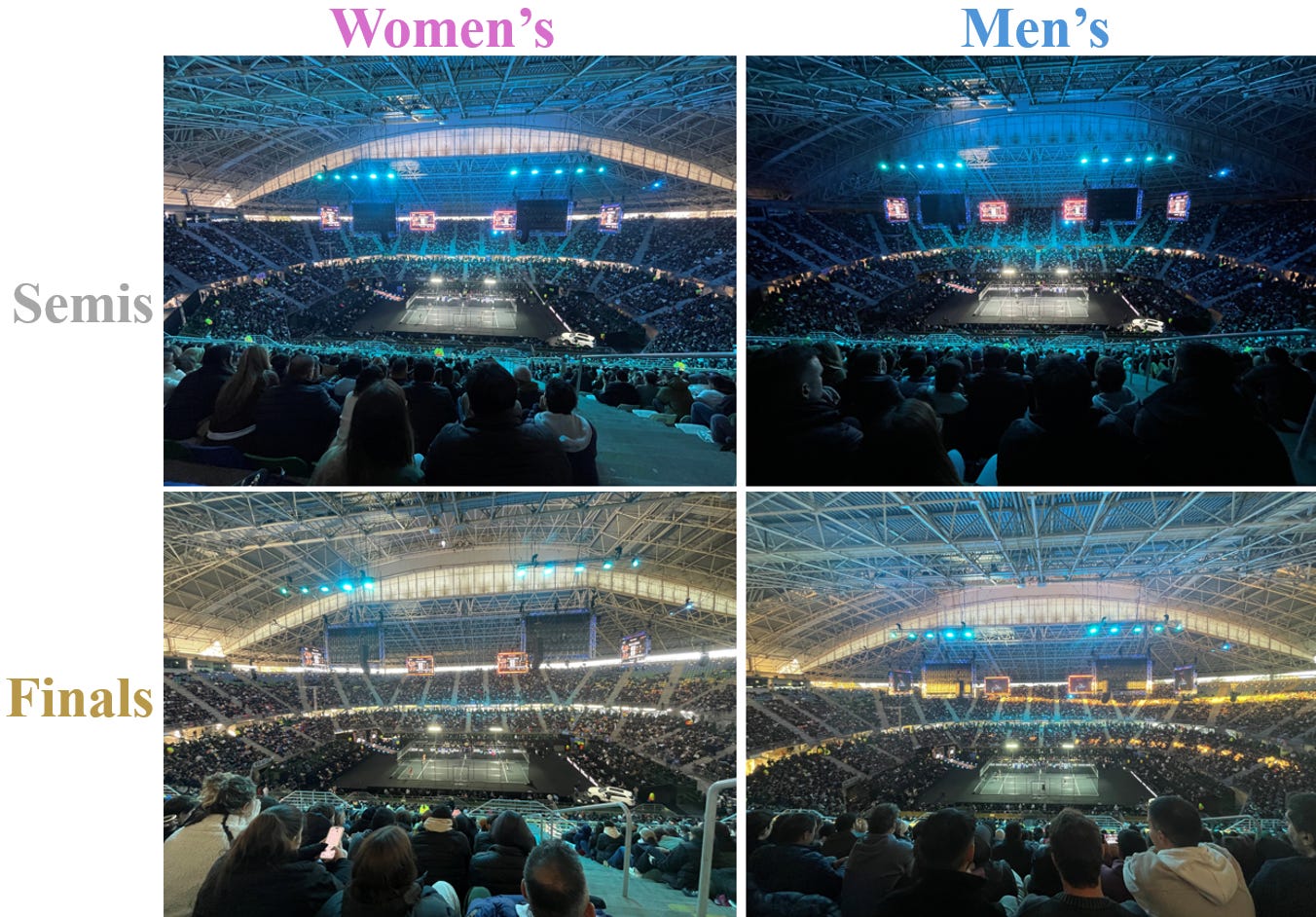
The semifinals drew a world-record 16,920 spectators—more than the final itself—likely thanks to cheaper tickets, a four-match slate instead of two, and more time for the atmosphere to build.
And to my astonishment, the majority of random locals I talked to had no idea the tournament was happening that week. Unlike Miami, they at least knew what padel is, but their reactions were usually somewhere between “they have events like this here?” and “wait, the pros are in town?” Even in one of the most mature padel markets on earth, the gap between people who play and people who follow the pro circuit seems almost as wide as it is in the US. 🤯 However, to give Buenos Aires credit, they installed a pop-up court directly beneath the city’s iconic Obelisco with people playing on it throughout the days leading up. Naturally, tons of folks stopped and watched. If us Americans are looking for a playbook move to steal for future Miami (or other US city) P1s, this is definitely one.
The women get real love here.
In Miami, I noted an uncomfortable crowd gap between men’s and women’s matches (~2-2.5x more fans in the stands for the men). Buenos Aires was a completely different story, with essentially full crowd parity. As a disclaimer, I’d say slightly more bodies were in seats for the men’s matches, but I think that’s a function of tournament scheduling and infamous Argentine punctuality (or rather, lack thereof). Women’s matches always came first; by the time the men started, more people had trickled in. Regardless, I think the difference is negligible and can tell you firsthand the spirit and enthusiasm of the crowd never changed.
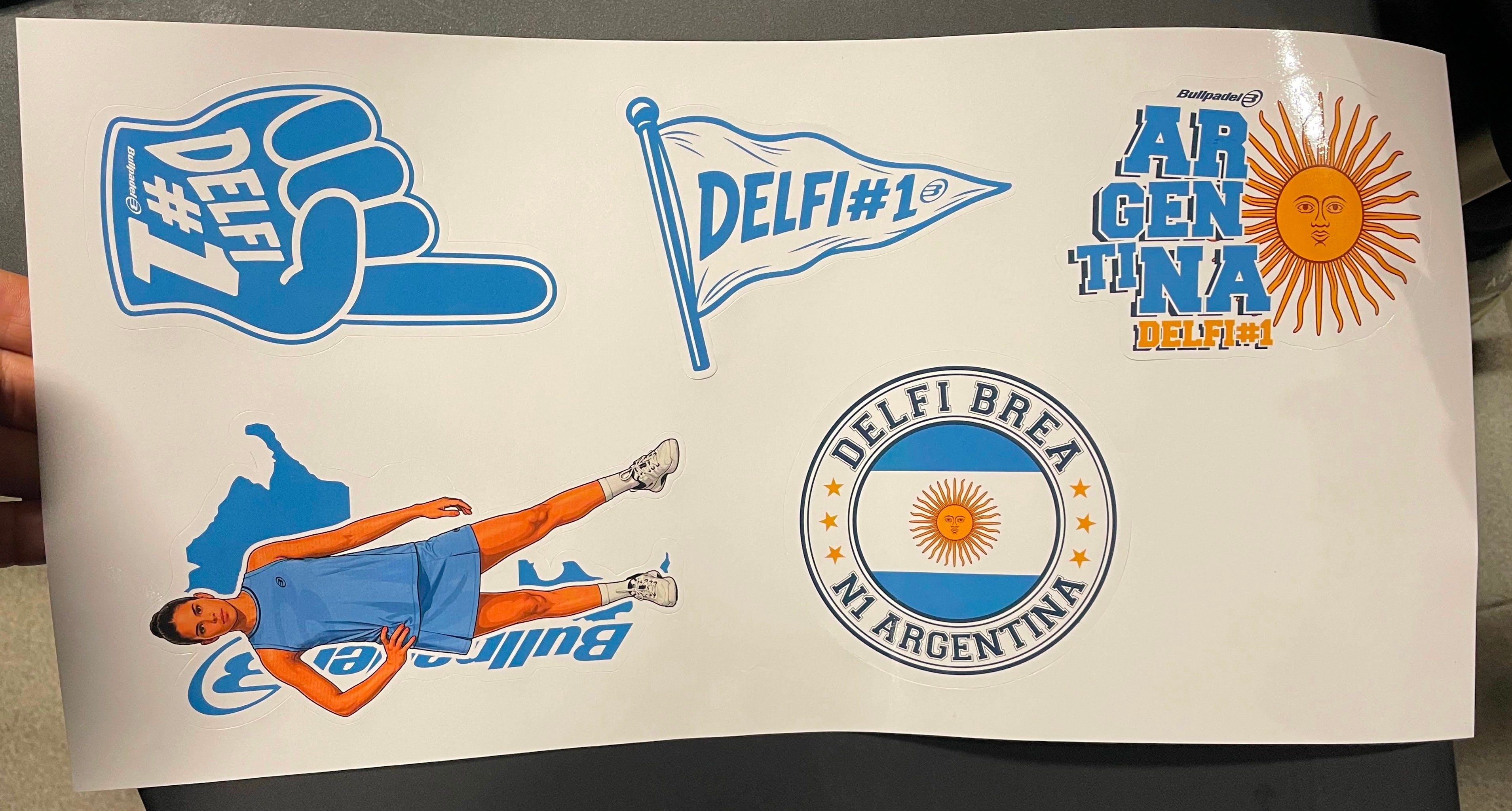
Point being, the women’s matches drew huge crowds, noise, and passion. Fellow Argentine (and women’s No. 1) Delfi Brea, in particular, had a paparazzi-like following. Fans were waving signs and sporting Delfi masks, while Bullpadel made Delfi stickers (see below). The US isn’t there yet, but ojalá soon.
The next generation is already built in.
Kids were everywhere, and it was by design. Here, local youth padel schools and federations receive free or heavily subsidized group access. One regional push alone, for example, brought 620 kids across 21 padel schools to a single day of the tournament. This is the perfect playbook for how the long-term fan pipeline takes care of itself. Miami, take notes.
They had how many racket brands?
I walked through a seemingly endless tent of padel racket brands and shot an Instagram reel documenting every brand represented. I’ll let you go watch it and count yourself. TLDR, unless you’re a household name like Bullpadel, Nox, Babolat, Siux, Head, etc., capturing market share must be a steep uphill battle.
Here are additional ideas I'd steal for a US event.
A couple of these you've already read about above, such as the pop-up Obelisco court and youth subsidization. Some extras worth spelling out explicitly:
Silent sponsor graphics instead of looping commercials. Buenos Aires had no commercials through the quarterfinals, and even at the semis and finals, sponsor messaging ran as silent on-screen graphics. Qatar Airways (the main sponsor) still got their point across without being a buzzkill, and the event “breathed” more as a result. Meanwhile, Miami had four sponsor commercials on a loud, repeating loop each day that are now practically tattooed into my brain.
Better VIP seating. This is admittedly pretty petty, but Buenos Aires VIP boxes had couches, tables, and footrests. Miami’s contained four rows of un-cushioned seats.
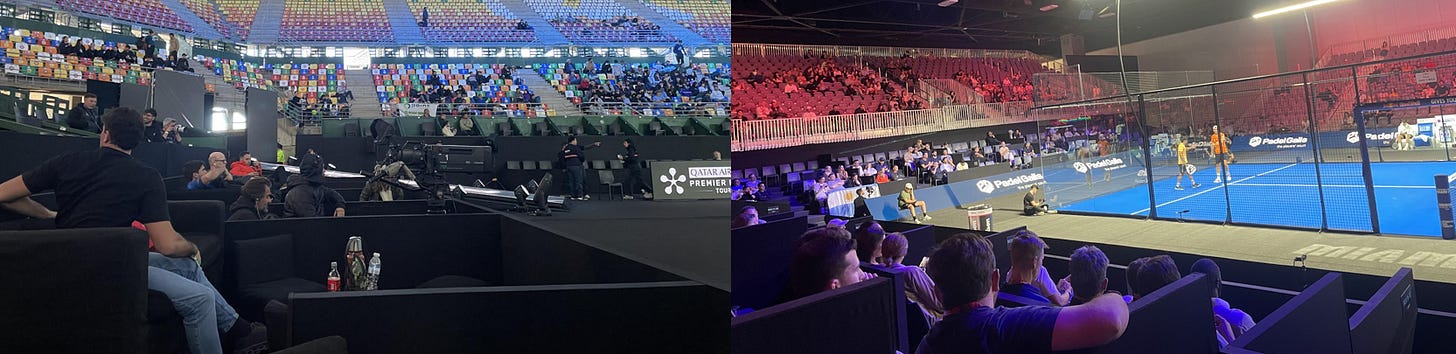
VIP boxes in Buenos Aires (left) vs. Miami (right)

Here’s where you should sit.
I rotated through virtually every section of the central court stadium over the course of the week, which gave me a pretty clear picture of the viewing experience from each angle. Imo, if you’re close to the court, sit behind the back glass. You get the players’ perspective, you’re not looking through the metal cage (or reja, rather), and the intimacy is unmatched. If you’re farther up, sit on the side; the elevated, horizontal view of the full court gives you a much fuller POV.
You gotta go.
And look, I thought Miami was fun, and I still highly recommend. But seeing the sport in its native habitat is a different kind of education. You understand the context and learn a couple things you can bring back to your local club. You meet folks you’d never cross paths with otherwise. And it creates one hell of a story you’ll have for the rest of your life. As an American who made the pilgrimage, I see Buenos Aires as a “north star” or reminder that the next decade of American padel will require a different kind of infrastructure than the exclusive model most US clubs are currently defaulting to.
I can and will do this again. If you ever want to tag along, hit me up!
— Aris
Missed a recent issue? Todo tranca che ;) we got you covered:
📌 Hot take editorials:
Thanks for reading! My promise: I’ll keep the newsletters coming, you share with a friend if you’re enjoying. Está bien? Forward to a friend.
For more on-the-ground 🌎 padel content from a 🇺🇸 POV, follow @padelyanqui on Instagram! 🤝 And if you have any feedback or news to share, just respond to this email :)
Hasta pronto & keep smashing those volleys 🎾
Vamos Ari, good listen para me🏓
Ari, sounds like you had a blast, congrats! Nice recap, great length. Kev