


Bienvenidos a El Remate! I’m Aris, a padel-obsessed Missourian who spent the last two years living in Argentina and Spain to deeply understand the sport’s strategy, culture, and business. I’ve played and competed across 3 continents and 12 countries, and recently started documenting my journey on Instagram.
If you’re new here, you can join our community of padel-addicted subscribers receiving my weekly newsletter on what’s hot in 🇺🇸 & 🌎 padel + occasional editorials (like this one) by adding your email below.
This one’s a bit different from the usual Tuesday rundown.
Miami Beach, no windows, neon lights, house music at 10am. Coello sitting in the bleachers like a regular person, Carlos Alcaraz two rows in front of me. And let’s not forget OnlyFans sponsorships. I watched every match from qualifiers to the final. In no specific order, here’s what I saw:
1) The pros are still just people.
Monday and Tuesday were the qualifier days. The big names hadn’t started playing yet, but there they were, chilling among the rest of us. On separate occasions, I saw Tino Libaak and Arturo Coello watching early-round matches in the bleachers with their respective girlfriends, completely mixed in with everyone else.
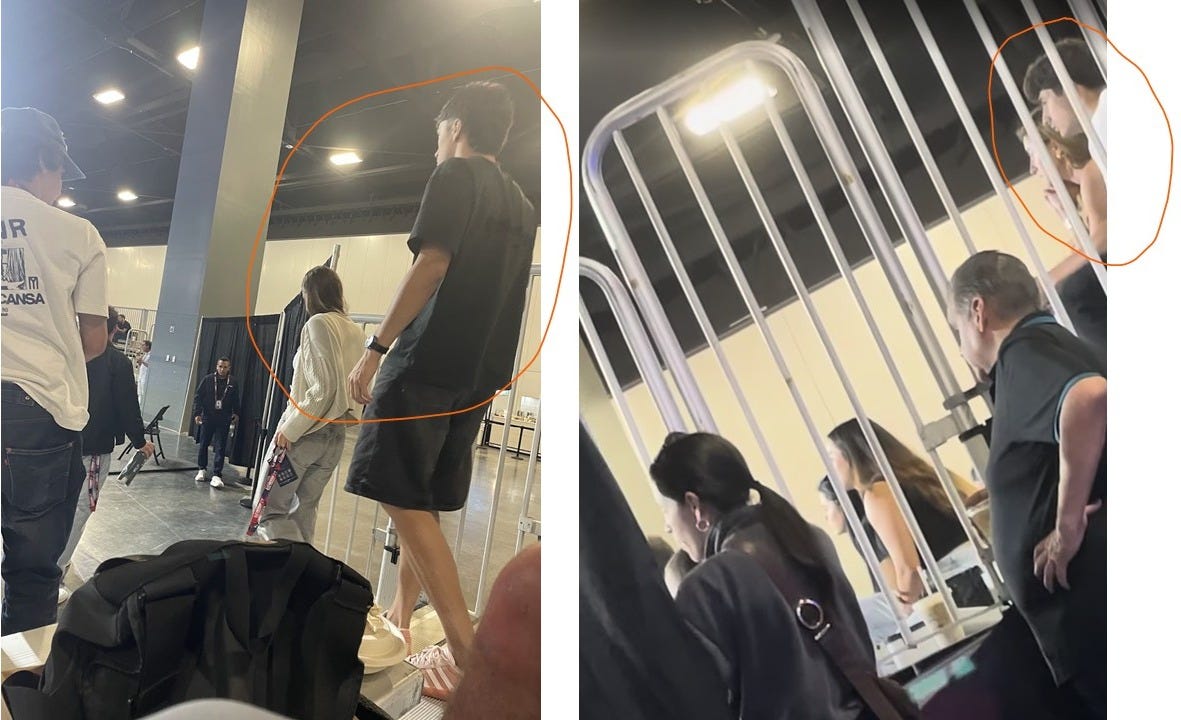
I remember when a match ended, people started leaving the stands and crowding around Coello for autographs and photos. He kindly obliged.
As much as I loved this, I sadly don’t know how much longer stuff like this will last. As padel grows (especially Stateside), the machinery of professional sports fame will start building the walls it always builds. Enjoy this era while it lasts.
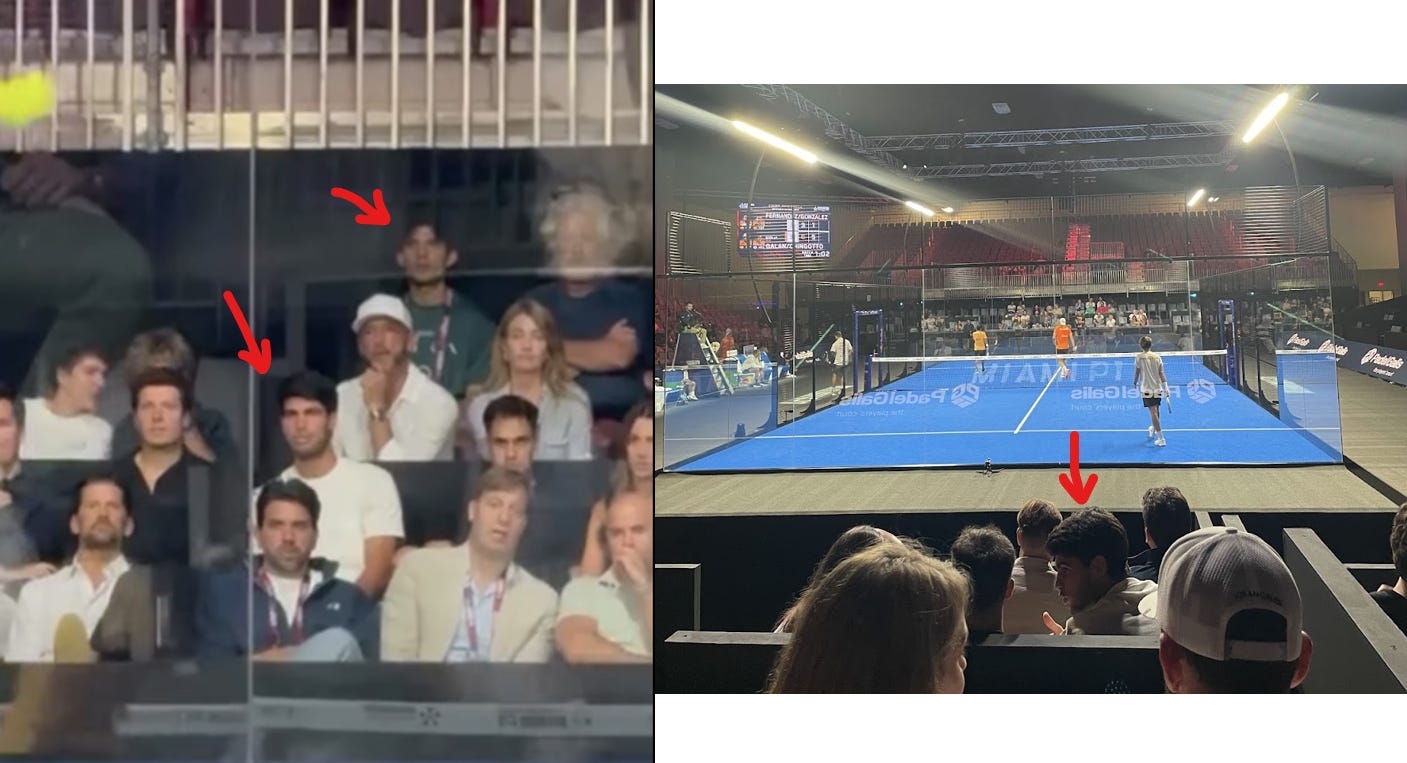
2) Carlos Alcaraz showed up for the Round of 32.
He was in a VIP box for the Round of 32. I somehow — before he arrived — ended up in that same box (thank you, media pass privileges 🫡), and found myself sitting two rows directly behind him. A random yokel from Missouri, sitting behind one of the best tennis players alive, watching the best padel players alive. Yeesh… what am I doing here?
I feel that Alcaraz simply being there matters beyond the celebrity angle. Tennis and padel are in a complicated relationship: parallel cultures, overlapping fanbases, competing court time. Take it for what it is.
3) Lefty-righty pairs are everywhere.
As an upper-intermediate rec player (or 4.22 on Playtomic after playing for 5 weeks in Spain), I don’t often face lefty-righty pairs. At this tournament, they were everywhere, and I didn’t think that was a coincidence.
Here’s my theory / the tactical reality: hitting down the middle (aka, the lowest-error shot in padel) is taken for granted when both your opponents are righties. Against a lefty-righty pair, that same shot goes right into both forehands. Your safety valve now becomes their weapon.
Beyond that (and from my experience), your muscle memory is built around righty-righty patterns… i.e., where to lob, where to chiquita, which side has the weaker volley. A lefty flips the whole map. So at the professional level, this edge is deliberately cultivated. Watch for it… or “ojo,” as they say.
4) Angle shots are a first language.
At my level, I avoid steep angles. The margin for error drastically shrinks, and I can usually depend on consistency to win points while my opponent makes mistakes. At the P1 level, angles are the vernacular.
Watching literally everyone — from the Qualifiers to the Final — hit cross-court at angles that seem geometrically impossible from that position, and make it repeatedly, is a good reminder of how many shots you’re leaving off the table by playing safe. The pro game is purely a different game.
5) Women’s padel deserved a bigger crowd.
As a rough observational estimate, 2-2.5x more people were in the stands for men’s matches than women’s. Witnessing that gap was uncomfortable to watch.
Before anyone tries to stop me and tell me I’m “virtue signaling,” here’s my blunt take: women’s padel is a different style of padel, and in some ways a more instructive one. The points are longer. The rallies are more constructed. The defense-to-attack transitions are more deliberate. (Here’s the info to back it up.) If you’re trying to improve your own game, you will learn more per minute watching women’s padel than men’s padel, because the men’s game operates at a pace and power level that’s simply not replicable for most of us. Also, isn’t it just cool to see what each gender of the human body is capable of doing on a padel court?
I grew up ball-boying for World Team Tennis, which ran men’s and women’s in the same ticket, same crowd. The women got real love. Padel in the U.S. isn’t there yet. Ojalá it gets there.
6) Miami didn’t know this was happening.
I (very) naively went into the week expecting some ambient awareness of the tournament throughout the Miami area. Hotels with padel fans. Restaurants / bars mentioning the event. The general “Miami-is-excited-about-this” energy. My mental benchmark was Dallas during Texas-Oklahoma weekend, something I experienced firsthand every October in college. When both teams come to town for the Cotton Bowl, you feel it everywhere. With Miami being the unquestionable padel capital of the US, I assumed that meant the P1 would land similarly.
None of that existed. Outside the convention center in Miami Beach, this tournament might as well have been invisible. The city did not seem to know or care. Expos for other industries were going on at other halls adjacent to the tournament. Visitors were at their hotels, pools, or restaurants for entirely unrelated reasons. Heck, even at the men’s final (objectively the highest-attended match), there was still a handful of open seats.
Admittedly, I’m probably in the 0.0001% of Americans who follows pro padel closely enough for this to register as a surprise. Most of the people in those stands were Spanish speakers (and from my POV, most of those accents seemed to have come from Argentina, Spain, Mexico, and Colombia). After all, much of our country’s still-nascent padel culture runs through the Latin community, not through our broader sports mainstream. That’s fine, and honestly pretty cool. That’s the early-adopter phase of a sport’s growth in a new market. The question is whether the next five years look like exponential growth or plateau. I think exponential. But the proof is in the attendance numbers, and the attendance numbers in 2026 still have room to grow.
7) The box seats were a networking event with padel as the backdrop.
Not sure how I feel about this one, as someone who sat in both. In the main grandstands, people were locked in. In the VIP boxes, people were busy showing face — leaving mid-set, moving to different boxes, reappearing, disappearing. Even at the semi-finals, with the top-four seeded teams in the world on court, some boxes had half their occupants gone by the second set. Those tickets are expensive. The players on court are the best in the world. And people seem to be coming for completely ulterior motives.
I’m not judging anyone’s reason for being there. After all, I haven’t walked a mile in their shoes. Industry events are industry events. But it did produce a surreal visual: an electric match between top-ten players, watched by a fluctuating, half-engaged population of “very important” people. Worth keeping an eye on as the sport scales.
8) OnlyFans is sponsoring players, and I had many questions.
Two initial observations:
Over the course of the tournament, I couldn’t help but raise my eyebrow when seeing a handful of male and female players competing with the OnlyFans logo on the back of their shirt. I mean I get it, sponsorship money is sponsorship money, and padel players outside the top-20 are not earning life-changing prize purses.
Like no offense to the company, but what are they even trying to accomplish in padel, especially among brands like Babolat, Heineken, On, Rolex, Red Bull, Bullpadel, and Prada? What’s the conversion funnel? Just feels like a really expensive opportunity cost.

But after educating myself (while going down a 2-min rabbit hole), it started making a bit more sense… I guess. TLDR, the brand entered padel in 2024 to diversify its image beyond adult content, promote the “OnlyFans sports” sector, and provide athletes with direct funding and content monetization opportunities.
Regardless, I still think it’s kinda funny. No further comments…
9) The wiping-hands-on-glass habit is 🤢
I’ll admit this is very much a personal opinion, but I’ll let it rip anyway: every single player, at some point, wiped their sweaty-ass palms on the glass. I see this occasionally at club level, but at the pro level it’s constant and almost ritualistic.
Here’s my issue. I don’t care how often José comes onto the court, the glass is never clean. There’s always ball residue on it. Other players’ sweaty hands have been on it. If you wipe your hand on the glass and then regrip, you’re weakening your grip and adding foreign debris to your handle. Doesn’t a wristband solve this problem entirely? Maybe the pros know something I don’t, but until someone explains it to me, this one stays on the weird list.
10) It’s 2026 at the pro circuit. Why aren’t we using AI to call shots?
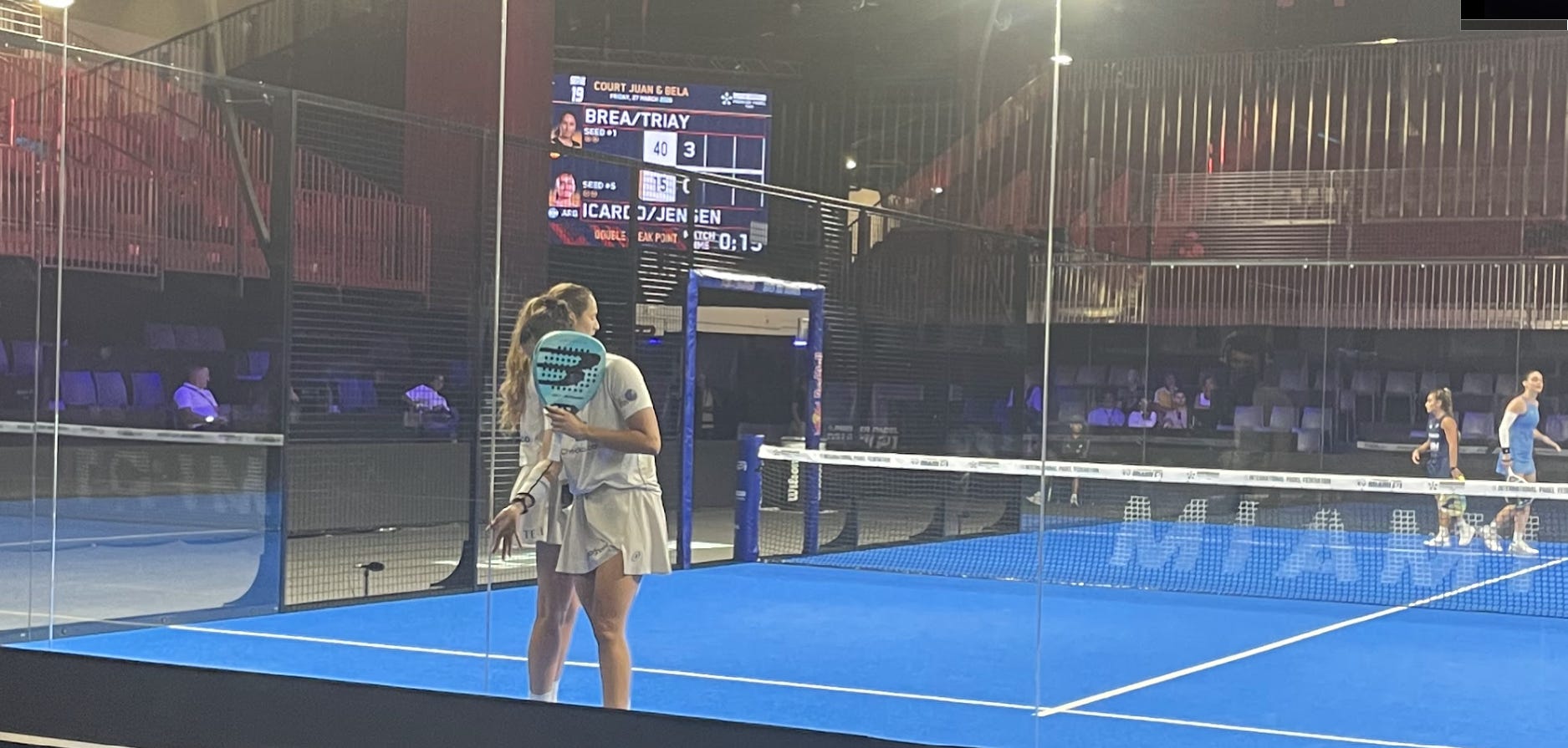
Each team gets two “challenges” per set. In the instance of a challenge, the match awkwardly pauses while the chair umpire reviews the replay as “The Pink Panther Theme” hums in the background. Genuinely funny. Also genuinely absurd.
I’m just kinda surprised at this still, given there have been dozens of press releases around AI line-call technology and how it’s “already transforming” racquet sports. None of that was in this building. The umpire’s word + two challenges per set is where we are. I assume this changes, I just don’t know when. For now, I guess 2018’s calling?
11) Some technical difficulties, and that’s okay.
The programming had some rough edges, and they weren’t hard to spot. At one point, Bad Bunny’s NUEVAYoL cut in over the PA while Coello was mid-serve (the point continued anyway). I remember something similar happening in one of the women’s quarterfinals. The scoreboard graphics glitched out a couple of times and occasionally failed to update the game score. And if you watched online, you’ve probably already heard complaints about streaming quality.
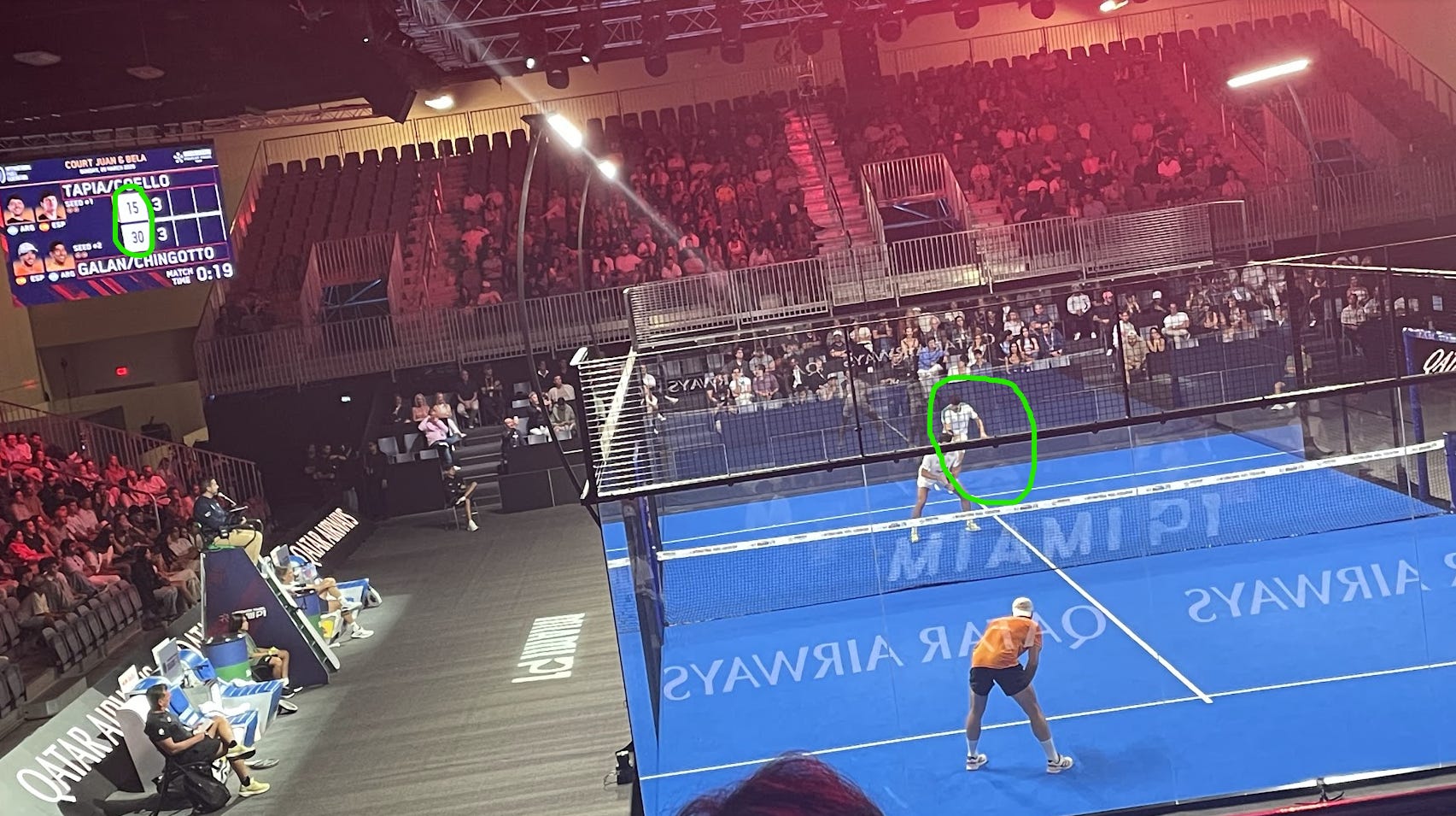
None of it killed the vibe. The energy inside the building never wavered. But this is not yet a precision operation, and it shows in the small stuff.
At the end of the day, this is purely an observation. They’re building six top-quality courts in five days inside a convention center hall that was doing something entirely different last week. Some friction is just baked in.
12) The better team won. Every time (almost).
The lone exception was the No. 1 seeds (both men’s and women’s) falling to the No. 2s in the final. Everything else tracked essentially perfectly to seeding throughout every round.
While the sport is beautiful to watch point-to-point, it’s highly predictable in aggregate. The same pairs keep winning, no matter how ugly. Each partner stabilizes one another. The bad patches get absorbed, so upsets are rare.
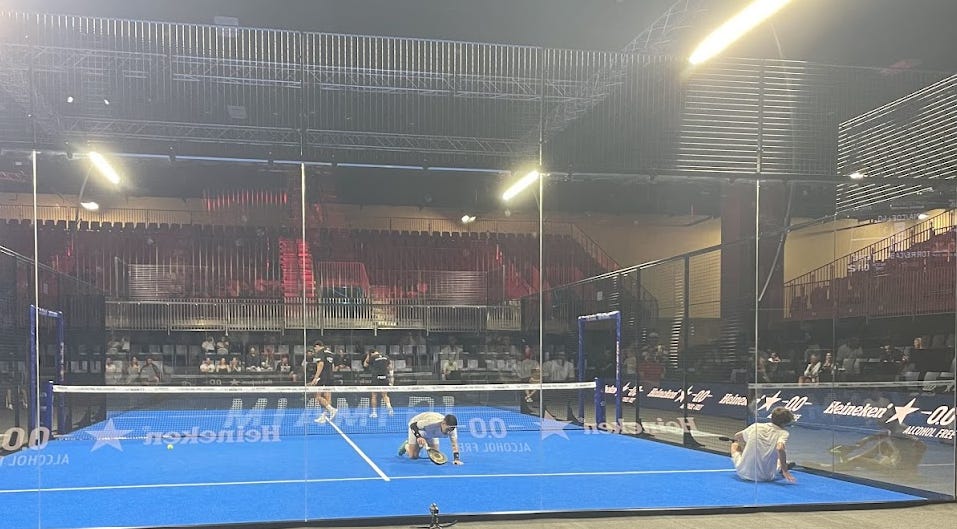
But if you’re watching padel for the craft, it’s extraordinary. Even in a lopsided match. Which leads me to…
13) Padel is objectively more fun to watch than tennis.
I’ve played and watched tennis my whole life. I will never stop playing and watching tennis.
But point-for-point, rally-for-rally, padel is a more engaging spectator sport. The walls create longer points with more reversals. Offense and defense flip back and forth constantly, with a lob resetting everything. You never fully know who’s winning a point until it ends. There’s no dead time between players shagging balls, because the enclosed court keeps things moving. And the atmosphere is uniquely intimate and buzzing.
In my humble opinion, tennis has padel beat on unpredictability of outcomes. Its sheer scale (i.e., five-set matches, four Grand Slams, 128-player draws, etc.) creates a kind of dramatic volatility padel simply hasn’t built (yet). Plus, singles produces more drama and more upsets. And the individual storyline of a player alone against another, with no partner being able to save you, carries a narrative weight that padel simply can’t replicate.
14) Miami P1 ≠ Premier Padel Tour
Last thing worth noting, which I had to remind myself: this (at least for now…) is the only Premier Padel tournament event on US soil. Everything I’ve described (i.e., crowd composition, atmosphere, awareness gap in the broader city, etc.) is specific to Miami, and Miami only. A P1 in Madrid, Buenos Aires, or Dubai is likely very different. To which degree I don’t know, but I sure as hell intend to find out. When I do, I’ll be reporting back. If you want to make a trip out of one of them, let me know. That idea is very much on the table.
TLDR: Go to one of these events. If you play, watching this level of padel in-person is one of the fastest ways to level up your game (it's pure osmosis). And even beyond that, it broadens your horizons. It's fun as hell either way. I'm already counting down to the next one.
Missed a recent issue? Todo tranca che ;) we got you covered:
📌 Hot take editorials:
Thanks for reading! My promise: I’ll keep the newsletters coming, you share with a friend if you’re enjoying. Está bien? Forward to a friend.
For more on-the-ground 🌎 padel content from a 🇺🇸 POV, follow @padelyanqui on Instagram! 🤝 And if you have any feedback or news to share, just respond to this email :)
Hasta pronto & keep smashing those volleys 🎾
Aris, great article and couldn’t’t agree more on all points. Enjoy watching the men play, but the women…the best learning how to be tactical. And for all the guys that believe they could hang with the top women…nope, not a chance. Having sat courtside while they practiced their slams…they are mostly tiny, yet can hit harder than most non-pro men. TV seems to slow things down, in person, wow! Anyway, great read and keep up the great work Aris!